

| The Very Highest Quality Coins... |
| The Story of the British Pound Coin | |

|
|
|
|
|
|
|
|
|
|
|
|
|
|
|
A £1 coin denomination is not, of course, new. The gold sovereign has been struck from 1489 until 1932, although it started to be replaced during the first world war. It has again been issued intermittently from 1957, although as a bullion and collectors piece rather than for circulation. Interestingly, the pound coin has a diameter almost identical to that of the sovereign (22.5mm), although it is much thicker (3.15mm). Perhaps the diameter and the use of a gold-coloured metal was intended as a homage to the old pound coin.
Gaining Popularity
The £1 coin was not very popular when it first appeared, but this is often the case. It promises to be quite an interesting series, in its first 16 years it has had 13 different designs, only repeating a previous design in the three
years 1990, 1991, and 1992. In my personal opinion, the ordinary nickel brass version is not particularly attractive, but the silver proof versions transform it into an attractive and beautiful collectors piece.
Prediction
It's our guess that the pound coin may be reduced in thickness in the next few years, and its weight reduced, in line with the two pound coin, which appears to be gaining in popularity.
1998, 1999, and 2000 Not Issued for Circulation
We have been informed by the Royal Mint that no pound coins were issued for circulation dated 1998 or 1999, although it is always likely that a few taken from collector's sets will reach circulation.
In 1998, the only versions available were silver proofs, proofs from the proof sets, and uncirculated coins from the mint sets.
In 1999, there were also specimen versions issued in folders, in addition to the types issued in 1998.
In 2000, all four sources are possible, plus silver piedfort proofs. The Royal Mint tell us, 9th October, 2000, it is likely that year 2000 pound coins will still be issued.
Summary of Pound Coin Designs
Because the design of the pound coin seems to change every year, it makes it slightly confusing to attempt to remember which design was made in which year.
To help simplify this, we have prepared a table of designs:-
| Date | Obverse | Reverse | Description |
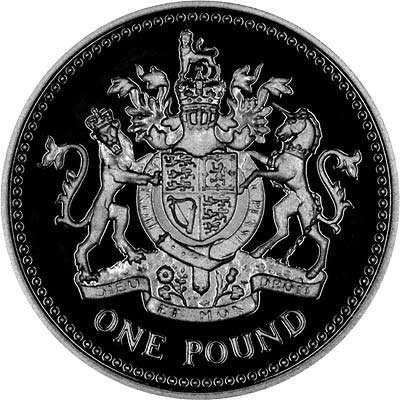
| 1983 | Decimal | Royal Arms | Coat of Arms |
| 1984 | Decimal | Scottish | Thistle & Crown |
| 1985 | Third | Welsh | Leek & Crown |
| 1986 | Third | Northern Ireland | Flax & Crown |
| 1987 | Third | English | Oak & Crown |
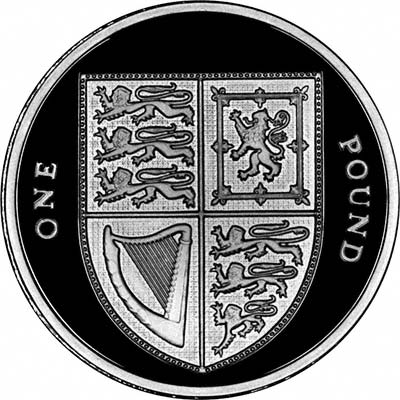
| 1988 | Third | Royal Shield | Shield |
| 1989 | Third | Scottish | Thistle & Crown |
| 1990 | Third | Welsh | Leek & Crown |
| 1991 | Third | Northern Ireland | Flax & Crown |
| 1992 | Third | English | Oak & Crown |
| 1993 | Third | Royal Arms | Coat of Arms |
| 1994 | Third | Scottish | Lion Rampant |
| 1995 | Third | Welsh | Dragon |
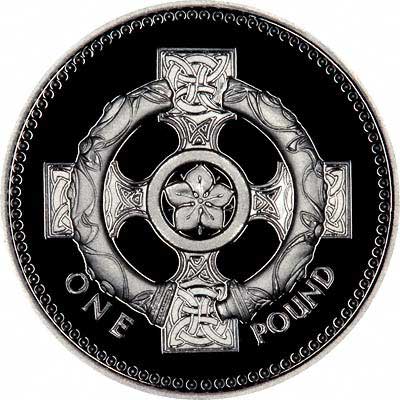
| 1996 | Third | Northern Ireland | Celtic Cross |
| 1997 | Third | English | Three Lions |
| 1998 | Fourth | Royal Arms | Coat of Arms |
| 1999 | Fourth | Scottish | Rampant Lion |
| 2000 | Fourth | Welsh | Dragon |
| 2001 | Fourth | Northern Ireland | Celtic Cross |
| 2002 | Fourth | English | Three Lions |
| 2003 | Fourth | Royal Arms | Coat of Arms |
| 2004 | Fourth | Scottish | Forth Railway Bridge |
| 2005 | Fourth | Welsh | Menai Straits Bridge |
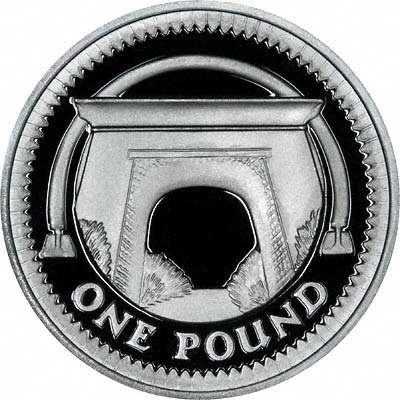
| 2006 | Fourth | Northern Ireland | Egyptian Arch |
| 2007 | Fourth | English | Millennium Bridge |
| 2008 | Fourth | Royal Arms | Coat of Arms |
| 2009 | Fourth | Royal Arms | Coat of Arms |
| 2010 | Fourth | UK Cities | London & Belfast |
| 2011 | Fourth | UK Cities | Edinburgh & Cardiff |
| 2013 | Fourth | Floral | England |
| 2013 | Fourth | Floral | Wales |
| 2014 | Fourth | Floral | Northern Ireland |
| 2014 | Fourth | Floral | Scotland |
| 2015 | Fourth | Royal Arms | Updated version of the Royal Arms |
| 2016 | Fifth | Beasts of the Four Nations | Farewell / Last Round Pound |
| 2017 | Fifth | Nations of the Crown | First 12-Sided Design |
Type Chart of Every Pound Coin Design
World Pound Coins
We have a page listing £1 Coins of Other Countries.
If you want to find the value of a coin you own, please take a look at our page I've Found An Old Coin, What's It Worth?
| ...at the Lowest Possible Price |
|
32 - 36 Harrowside, Blackpool, Lancashire, FY4 1RJ, England.
Telephone (44) - (0) 1253 - 343081 ; Fax 408058; E-mail: info@chards.co.uk The URL for our main page is: https://24carat.co.uk |
Web Design by Snoop |