

| The Very Highest Quality Half Sovereigns... |
| The Story of the Half Sovereign | |
|
|
 |
|
|
|
|
|
|
|
|
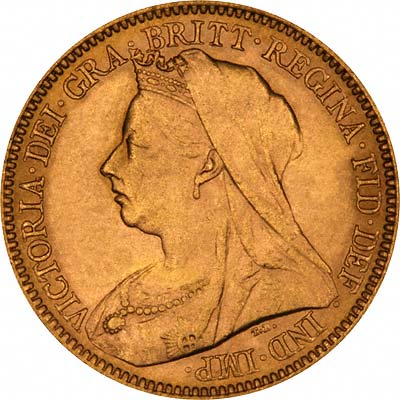
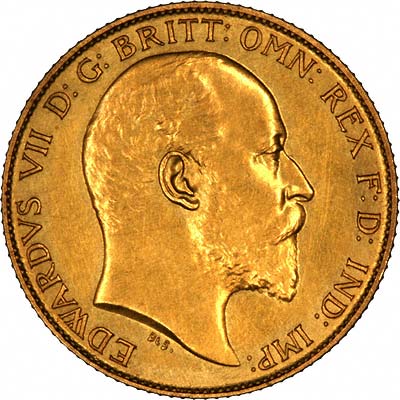
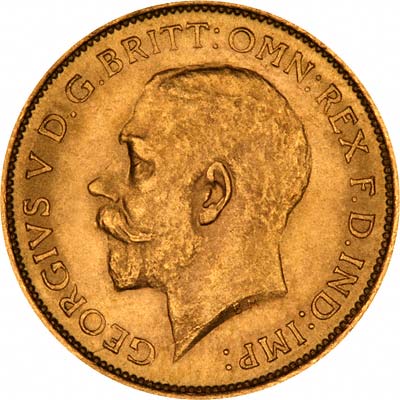
Although the gold sovereign came into existence in 1489 under King Henry VII, the half sovereign was not issued until 1544 in the reign of Henry VIII. Apart from this, the history of the half sovereign follows a similar pattern to that of the full sovereign.
The original value of a half sovereign was ten shillings, and apart from some fluctuations because of differences in gold bullion prices, this has remained its face value to this day.
The original design was basically a smaller version of the full sovereign
Half sovereigns were then struck for Edward VI, and for most monarchs until the first coinage of James I. From James' second coinage, the half sovereign was issued up to and including 1604, then discontinued.
With the introduction of regular machine made "milled" coinage under Charles II, the half guinea was introduced,
with a value originally of ten shillings, but later of ten shillings and sixpence.
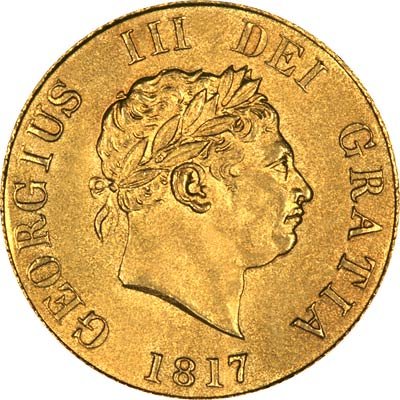
In 1816, there was a major change in the British coinage, powered by the Industrial Revolution. The Royal Mint moved from The Tower of London to new premises on nearby Tower Hill, and acquired powerful new steam powered coining presses designed by Matthew Boulton and James Watt. The modern half sovereign was born!
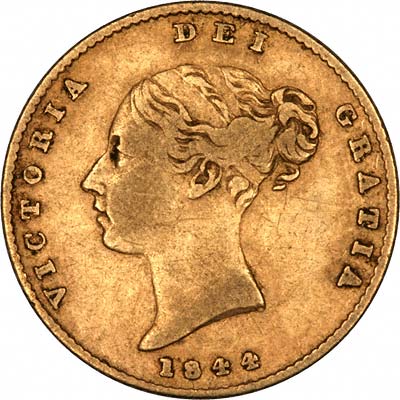
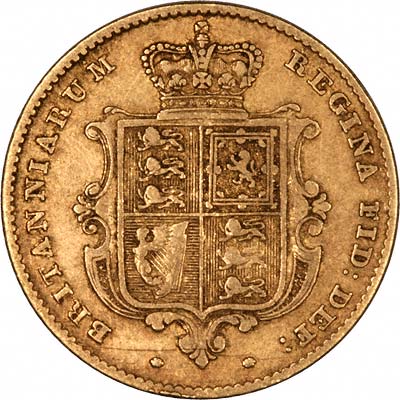
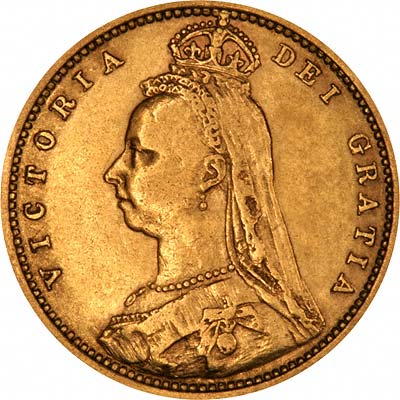
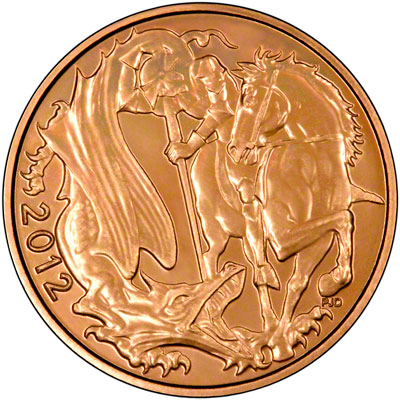
A new reverse design was introduced for the full sovereign featuring Saint George slaying a dragon, designed by a brilliant young Italian engraver, Benedetto Pistrucci. The device on the reverse of the modern half sovereigns from 1817 to 1887 was a crowned shield in various designs. From the introduction of the jubilee head issues of Queen Victoria in 1887, the St. George and dragon design of Pistrucci's was adopted for the half sovereigns. This beautiful classic design remains on our half sovereigns today, over a hundred years later, and for most of its life must have been one of the worlds most widely recognised coin designs.
During the first world war, Britain needed gold bullion to finance the war effort. Banknotes were introduced into
regular circulation, and within a few years, sovereigns and half sovereigns ceased to be used in everyday transactions. Production of half sovereigns
at the Royal Mint stopped in 1915, and also at the Melbourne mint.
The other branch mints continued to produce half sovereigns, Sydney
Australia until 1916, Perth Australia until 1920, and Pretoria South Africa until 1926.
No further half sovereigns were then issued for circulation until 1982, although half sovereigns were included in the George VI proof
set of 1937 which was available for collectors, and half sovereigns were also minted but not issued for Edward VIII in 1937,
and for Queen Elizabeth II in 1953.
In 1980 and 1982, a proof version was issued, and this continues to the present.
In 1989, a special 500th anniversary commemorative design was produced, inspired by the very first gold sovereign of 1489,
showing H.M. Queen Elizabeth II seated facing on a throne.
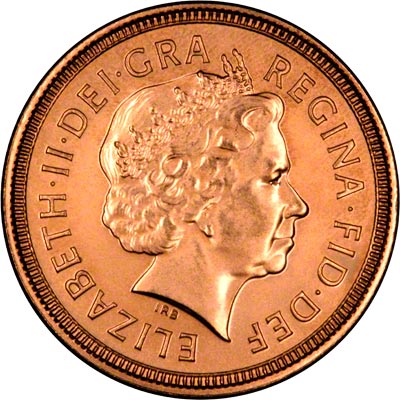
It appears likely that gold half sovereigns will continue to be struck every year for sale to collectors. They have become a very popular gift item for christenings and other special occasions.
From 2000 onwards, the Royal Mint have produced two versions of half sovereigns, an ordinary bullion grade, and a proof edition.
If you want to find the value of a coin you own, please take a look at our page I've Found An Old Coin, What's It Worth?
If you have an enquiry about any of our Gold Half Sovereigns, we'd be happy to answer you, but please note it may be quicker to telephone us. Please see the Contact Us page of our website.
| ...at the Lowest Possible Price |
|
32 - 36 Harrowside, Blackpool, Lancashire, FY4 1RJ, England. Telephone (44) - (0) 1253 - 343081 ; Fax 408058; E-mail: The URL for our main page is: https://24carat.co.uk | Chard(1964) Ltd |